Feature Engineering
Definition
Feature engineering is the process of transforming raw data into meaningful inputs (features) that machine learning models can understand.
Why it matters
The quality of your features often matters more than the choice of algorithm.
A well-chosen feature can reveal hidden patterns, making the model smarter and more accurate.
Analogy
Imagine you are predicting whether a basketball player will score.
Raw data might be: player’s height, team name, jersey number, last game date.
After feature engineering, useful features might be: average points per game, shooting percentage in the last 5 games, fatigue level, opponent’s defense rating.
Same raw data, but better structured information.
Key Types of Feature Engineering
Cleaning Fixing missing values, removing duplicates, converting data types.
Transformation Scaling numbers, normalizing values, encoding categorical data.
Creation Making new features from old ones.
Example: from “Published Date” you can create “Hour of Day,” “Day of Week,” “Is Weekend.”
Selection Choosing the most important features to avoid noise.
“Feature engineering is how we turn messy real-world data into the smart signals that help AI make better predictions. It’s less about magic algorithms and more about asking the right questions of your data.”
We will look at a the dataset from Austin Traffic Data dataset Source and discuss the various Feature Engineering Tasks.
# import the library and create the DataFrame
>>> import pandas as pd
>>> data = pd.read_csv('sampled_ATX_Traffic.csv')
>>> data.head()
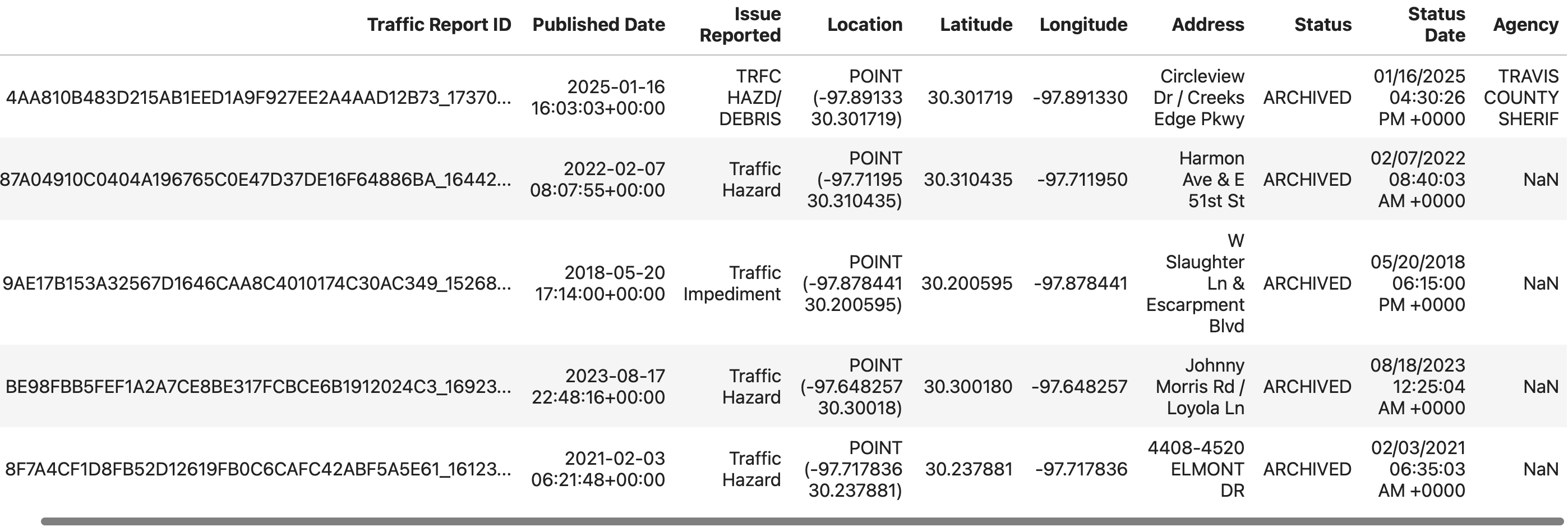
Feature Engineering Tasks
Datetime Features (from Published Date)
Derived Feature |
Purpose |
|---|---|
Incident Hour (0-23) |
Identify time-of-day patterns |
Day of Week (0-6) |
Capture weekday/weekend behavior |
Weekend Flag |
Binary flag (1 = Weekend, 0 = Weekday) |
Categorical Encoding
Feature |
Encoding Method |
Notes |
|---|---|---|
Issue Reported |
One-Hot Encoding or Label Encoding |
High cardinality may require frequency encoding |
Agency |
One-Hot Encoding |
Depends on how many unique agencies there are |
Spatial Features (Latitude/Longitude)
Transformation |
Purpose |
|---|---|
Distance from Downtown (30.2672, -97.7431) |
Proximity to city center |
Latitude & Longitude Scaling |
Normalize for distance-based models |
Location Clusters (Optional) |
KMeans or DBSCAN clustering on coordinates |
Address Text Feature Engineering (Optional but Valuable)
Transformation |
Purpose |
|---|---|
Extract Street Names |
e.g., “E 6th St” |
Road Type Flag |
e.g., Highway, Service Road, Blvd, etc. |
Text Length of Address |
Indirect signal for address granularity |
Feature Scaling
Feature |
Scaling Method |
|---|---|
Latitude, Longitude, Distance |
MinMaxScaler (scale to 0-1) |
Time-based Features (if numerical) |
StandardScaler (mean 0, std 1) |
Target & ML Goals
Task |
Target Feature |
ML Type |
|---|---|---|
Classification of Incident Type |
Issue Reported |
Multiclass Classification |
Cluster Incident Hotspots |
Latitude/Longitude + Time |
Clustering (KMeans/DBSCAN) |
Bias Detection by Agency |
Agency vs. Incident Types |
C lustering/Exploratory Analysis |
Summary:
- Traffic incidents are inherently temporal.
Patterns in collisions, hazards, and stalled vehicles follow time-of-day and day-of-week rhythms.
- Machine Learning models don’t understand timestamps.
They need explicit numerical or categorical features representing patterns (e.g., rush hours, weekends).
For Clustering, time-of-day and day-of-week help reveal “incident patterns” that are spatial-temporal:
Where and when do collisions spike?
Are stalled vehicles more common on weekends?
For Classification, datetime-derived features add valuable predictive signals:
If it’s Friday 5 PM, there’s a higher chance it’s a collision.
If it’s Sunday afternoon, it might be a hazard or road closure.